
Cart
0
You may also like



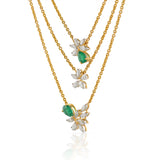
The trick to layering necklaces for a South Indian wedding is not about wearing more jewellery — it is about giving each piece its own space. Build three distinct layers: a choker near the collarbone, a transition necklace in between, and a long haram at the bottom — then ground the look with a vaddanam at the waist. When every piece is visible and none is swallowed by another, the result is elegant and regal, not cluttered.

The trick is not about having more jewelry on. It's about giving each piece its space.
Layering South Indian bridal jewelry is all about having three different layers: a choker layer that lies near the collar bone, a transition layer that lies in between, and the long haram that lies at the bottom.
Each piece of jewelry gets its space; the outcome? Elegant, and not cluttered!
It is easy to assume that the more the jewelry, the more bridal you become. However, the best-looking combinations are not always those made up of the most pieces. Instead, they are those in which all the necklaces can be seen.
The jewelry can be viewed as a visual story that starts from the choker to mid-length necklace to long haram.
It all starts right up front and near the face.
The pearl and tassel choker provides the basis for everything else layered on top.
It needs to fit snugly without feeling uncomfortable, defining the neckline, yet still leaving some room underneath.
Consider the level one choker the framing device.

The second necklace takes the whole look to another level.
A Kundan and emerald necklace or a Guttapusalu inspired necklace adds color, embellishment, and some length while not taking away from the choker necklace.
It's at this stage that the combination of pearls, emeralds, kundan, and the ruby color tones can really work well.
The principle is very simple: You need to be able to tell which necklace ends where and which begins.
This line falls lower than the mid length necklace, forming the longest line in the design and contributing to the regal aura of the bride's silhouette.
It does not add another busy line, but rather brings the jewellery journey full circle, from the neckline to the waist.
This is the element which completes the whole design.
The necklaces make vertical movements; the vaddanam makes a balance. When worn on the waist, it is the fourth horizontal level which makes the whole look of the bride grounded.
All these jewels make for a natural progression: Face → Collarbone → Chest → Waist — and suddenly all those jewels become one look.
And it may be one of the simplest ways to check if you've achieved proper layering — the only requirement here is that you be able to see all three necklaces simultaneously. Never allow the beautiful choker to be swallowed up by another beautiful necklace, and do not allow the haram to be buried under all those other layers.
Because wedding jewelry is never about quantity but rather quality.
As you head out, one final check:
If your answers are all in the affirmative, then you're good to go. And once the jewels fall into place, the mystery is very simple indeed: Three layers. Space for breath. And a bride shining through.
Planning your bridal look? Speak to our bridal jewellery specialists at Krishna Jewellers.
Chat on WhatsAppA well-layered South Indian bridal look uses three necklaces — a choker near the collarbone, a mid-length transition necklace, and a long haram — often finished with a vaddanam at the waist. The goal is for each piece to remain visible rather than simply wearing as many as possible.
Layer from the neckline downward: start with the choker (Level 1), add the transition necklace in between (Level 2), then the long haram as the anchor (Level 3). The vaddanam at the waist adds a fourth horizontal level that grounds the whole look.
A Kundan and emerald necklace or a Guttapusalu-inspired necklace works beautifully as the transition. It adds colour, embellishment and length while letting the choker above it stay distinct.
You should be able to see all three necklaces at the same time. Never let the choker be swallowed by another necklace or the haram buried under the layers — wedding jewellery is about quality, not quantity.
A vaddanam is a waist belt worn by South Indian brides. Because the necklaces create vertical movement, the vaddanam adds balance as the fourth horizontal level, grounding the bride's silhouette from face to collarbone to chest to waist.


