
Cart
0
You may also like


When a family sets aside a meaningful gold budget for one significant necklace, the choice often narrows to two very different philosophies: a 22K gold long haram — one grand, pendant-anchored statement worn on the biggest occasions — or a multilayer gold chain that delivers rich, cascading layers of gold with the flexibility to dress up or down. Both can carry similar gold weight. What differs is how that gold works for you: concentrated ceremony versus everyday versatility. Here is how to decide.
Quick answer: Choose a 22K gold long haram if the necklace's job is grandeur — weddings, festivals, and heirloom presence, with intricate temple or antique work and a commanding pendant. Choose a multilayer gold chain if you want your gold working more days of the year — layered richness that suits silk sarees and office wear alike, with individual strands you can also wear separately. Same gold, different lives: the haram is an occasion piece; the multilayer chain is a wardrobe.
A long haram is South India's definitive statement necklace: a single continuous design falling well below the collarbone — often to the chest or waist — worked in 22K gold with intricate motifs and almost always anchored by a substantial pendant. Temple harams carry deities and gopuram forms; antique-finish harams revive Nizam and Chettinad-era patterns; mango (mavidi) harams string paisley motifs edge to edge; kasulaperu and guttapusalu are themselves specialised harams within this family.
The haram's power is architectural. It creates a strong vertical line, fills the space a grand Kanjeevaram demands, and gives photographs a clear focal point. It is jewellery designed for moments when presence matters — the muhurtam, the reception, Varalakshmi Vratam — and it is the piece most likely to be spoken of, decades later, as "amma's haram."
A multilayer gold chain delivers its richness through repetition rather than a single grand design: two, three, or more strands of 22K gold worn together, either as a permanently joined multi-strand piece — the traditional chandraharam of graduated chain layers — or as separate chains of stepped lengths styled as one look. The strands may be simple rope, wheat, or box links, beaded gundla-mala style rounds, or a mix of textures that catch light differently at each level.
The multilayer chain's power is versatility. Worn together, the layers create near-haram richness for festivals and family functions. Worn individually, each strand becomes a refined daily-wear chain that works with a kurta, a sari, or a blazer. A pendant can be added to the longest strand for one occasion and removed the next. It is the necklace equivalent of a capsule wardrobe: fewer limits, more days worn.
| Feature | 22K Gold Long Haram | Multilayer Gold Chain |
|---|---|---|
| Design philosophy | One continuous, intricately worked statement with a focal pendant | Richness built from multiple strands of gold worn together |
| Presence | Commanding and ceremonial — designed to be the centrepiece | Elegant and layered — rich without dominating the outfit |
| Versatility | Occasion wear: weddings, festivals, grand functions | Everyday to festive: strands work separately or together |
| Wear frequency | A few significant days each year | Potentially daily — each layer is independently wearable |
| Craftsmanship focus | Motif work, temple or antique detailing, pendant artistry — higher making charges | Chain-making precision and finish — generally lower making charges |
| Pendant flexibility | Pendant is usually integral to the design | Pendants can be added, swapped, or removed at will |
| Outfit pairing | Kanjeevaram and heavy silks, bridal and festive wear | Silk sarees, salwars, western and office wear alike |
| Heirloom character | The classic generational showpiece | Heirloom gold that can be divided — strands can pass to different family members |
| Budget approach | One larger purchase | Can be built strand by strand over time |
Here is the contrast made real — two pieces from our collection that embody each philosophy. Between them sits the same question this whole guide asks: one grand statement, or gold that works every day?

The long haram philosophy at its fullest: a cascade of intricately carved peacock and jhumka-inspired motifs in antique-finish 22K gold, building to a magnificent Lakshmi Devi centrepiece fringed with emerald beads and seed pearls. Every gram here is worked by hand into temple artistry — this is the piece the whole room notices, and the one the family will still be talking about in thirty years.
Purity: 22K • Gross weight: 128.37 g • Net gold: 109.57 g

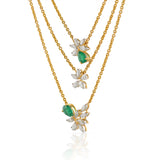
The everyday philosophy, twice over: a set of two yellow gold chains — a classic twisted rope chain and a delicate double-strand chain dotted with pearl stations. Made as a couple's pair, the two strands also show exactly how layered chain styling works: worn together they create the stepped, light-catching look; worn apart, each is a refined chain for any ordinary day. Gold that leaves the locker every morning.
Yellow gold • Total weight: 19.55 g • Gold: 18.46 g • Pearls: 5.45
The numbers tell the story better than any argument. The temple haram concentrates nearly 110 grams of 22K gold — six times the chain set's gold — into a single piece of ceremonial artistry, worn on the days that matter most. The chain set spreads a modest 18 grams across two strands that can be worn every single day, separately or layered. Neither allocation is wrong; they are answers to different questions. Prices are shown live against the day's gold rate on each product page, or message us on WhatsApp with the SKU for a full breakup.
Be honest with the calendar. If the necklace will emerge for two weddings and two festivals a year, a haram's concentrated grandeur is exactly right — that is its job. If it will sit in the locker eleven months a year and that troubles you, the multilayer chain's daily wearability means your gold earns its keep: one strand to work, two to a dinner, all three to the function.
Intricate haram work — temple motifs, antique finishing, nakshi detailing — carries meaningfully higher making charges per gram than chain-making, and rightly so: you are paying master artisans for irreplaceable handwork. Multilayer chains put a larger share of your budget into gold weight itself. Neither is better; they are different allocations. Ask for the making-charge percentage on both and decide which allocation matches your intent — wearable art or wearable wealth.
A haram passes down whole — one piece, one inheritor, one story. A multilayer chain offers a quieter advantage families rarely consider at purchase: decades later, three strands can become three gifts to three daughters or daughters-in-law, each a complete necklace in its own right.
If your locker already holds chokers and short necklaces but nothing with length and drama, the haram fills the gap no chain can. If you already own a bridal haram from your own wedding, a multilayer chain is usually the smarter next purchase — it covers the hundred ordinary-to-special days your haram is too grand for.
Beautifully — this is, in fact, the classic Telugu bridal formula in another form. A multilayer chain or chandraharam worn at shorter, graduated lengths fills the neckline, while the long haram sweeps below it as the anchor. The plain gold layers give the eye a rhythm that makes the haram's pendant stand out more, not less. If you are buying both over time, tell your jeweller — lengths can be planned so every piece you own layers cleanly with the others.
This choice is less about taste than about the life you want the gold to live. For ceremony, photographs, and the piece your granddaughter will one day ask about, the 22K gold long haram wins — nothing else delivers that presence. For gold you will actually wear across the year, style multiple ways, and even divide across a generation, the multilayer gold chain wins. If the collection is just beginning, our counsel is usually the chain first, the haram when the occasion that deserves it appears on the horizon.
Plain 22K gold is forgiving, but weight brings its own demands. Store harams flat or on a padded hanger so intricate links never kink under their own weight, and keep each strand of a multilayer set in its own pouch to prevent tangling — untangling knotted 22K chains is the most common (and most avoidable) repair we see. Clean with mild soap water and a soft brush at home, and have clasps and links on heavy pieces inspected yearly; a worn jump ring on a 100-gram haram is not a risk worth taking.
Gold value is identical gram for gram at the same purity, so both hold intrinsic value equally well. The difference is making charges: intricate haram work costs more to make, and making charges are not recovered at exchange or resale. A plain multilayer chain therefore converts a slightly higher share of purchase price into recoverable gold value.
Long harams typically fall in opera-to-rope territory — roughly 28 to 36 inches, with grand bridal harams longer still. Multilayer chains usually stagger between princess and matinee lengths — about 18, 22, and 26 inches — so each strand sits distinctly. Your height, neckline, and existing jewellery all affect the ideal lengths, which is worth finalising in person or on a video call.
A chandraharam is the traditional Telugu form of the idea: a single necklace of multiple graduated gold layers joined as one piece. Modern multilayer styling achieves a similar look with separate chains of stepped lengths. The chandraharam gives you a guaranteed, perfectly spaced fall; separate chains give you the flexibility to wear each strand alone.
Yes — that is one of its great advantages. A Lakshmi pendant on the longest strand takes the set from office-appropriate to temple-ready in seconds. Just ensure the strand's link strength suits the pendant's weight; your jeweller can confirm this in a moment.
Well-made harams distribute weight across the full length rather than the nape, and most brides comfortably wear substantial harams through long ceremonies. That said, if all-day comfort is a priority, mention it while selecting — flexible link construction and balanced pendant weight make a noticeable difference at the same gold weight.
Yes. Customers in the US, UK, Canada, and UAE regularly finalise long harams and multilayer chains over a live video consultation — comparing lengths and weights on screen — with hallmark certification, insured international shipping, or family pickup in Hyderabad.
Explore our 22K gold long harams and gold chains at Krishna Jewellers Pearls & Gems — trusted since 1983. Our experts will compare weights, lengths, and making charges with you, piece by piece.
Chat With Our Gold Experts
