
Cart
0
You may also like
A story of gold, prosperity and Telugu heritage
Kasulaperu is a traditional Telugu coin necklace made of small gold coins strung closely together. The name comes from kasu (coin) and peru (string or necklace). Most versions carry the Goddess Lakshmi motif, which is why it is considered auspicious and is worn widely as Telugu bridal jewellery. The same family of coin necklaces is known as Kasumala or Kasu Malai elsewhere in South India.
Some ornaments you simply wear. Others carry a piece of history with them. Kasulaperu belongs firmly to the second kind.
It consists of strands of small gold coins tied closely together, and it has been part of the Telugu ornament tradition for generations. Even its name tells you what makes it distinctive — kasu is a coin, and peru refers to the string or necklace. But Kasulaperu was never just a necklace with coins on it.
Consider a time when gold did not stay locked inside a jewellery box. Gold was portable wealth, and coin necklaces have long been associated with exactly that idea — value you could carry on your person.
Historical narratives link the broader Kasumala custom to periods of active trade, when gold coins circulated widely across South India. The coins used in these ornaments varied in their motifs depending on the period and the purpose they served.

Over time the idea evolved. Instead of stringing currency, craftsmen began making gold coins specifically to be worn as jewellery. In Telugu culture, this form came to be called Kasulaperu. What is remarkable about it is that it still reads as a string of coins — even though every coin is made deliberately, as part of the ornament itself.
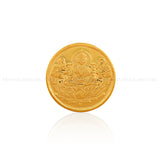
Look closely at a conventional Lakshmi Kasulaperu and you will notice Goddess Lakshmi repeating across the coins. Lakshmi is the goddess of prosperity and wealth, so placing her image on a piece built entirely around coin motifs makes the symbolism twice as deliberate.
Together, these turn what could have been an ordinary necklace into something considerably more meaningful. That is why Lakshmi Kasulaperu is traditionally treated as a wedding and auspicious ornament, and why it has long been described as a prized wedding piece and a favoured gift for brides in the Telugu jewellery tradition.
Kasulaperu is especially associated with Andhra and Telugu jewellery culture, and it is still recognised as a defining element of a Telugu bride's jewellery.

The Deccan has always been a crossroads — of cultures, trade routes, kingdoms and arts. The jewellery of the region mirrors that layered past, and Kasulaperu sits naturally within it. It is as rich as any traditional gold jewellery, as devotional as temple jewellery designs, and as rhythmic as coin jewellery gets. It survives today as living bridal jewellery in Hyderabad and well beyond.
The classical Kasulaperu was heavy, long, and unmistakably ceremonial — dense rows of Lakshmi coins in high-purity gold, built to be seen from across a wedding hall and to be handed down afterwards.
What has changed is not the idea but the execution. Today the same design language appears in lighter-weight strands that can be worn through a full day, in shorter choker lengths that sit well with contemporary blouse necklines, and in versions where the coins are framed with polki, uncut diamonds, rubies or emeralds. Some pieces reduce the coin rows to a single line with a statement pendant; others detach into two wearable lengths.
The constant across all of them is the coin. Change the metal weight, the length, the stones or the finish, and it is still recognisably a Kasulaperu. Change the coin, and it isn't.
There is a reason this piece sits so comfortably against a bridal saree. The gold finish creates a natural visual link with classic silks, and the coins give the necklace enough substance to hold its own alongside other bridal jewellery rather than disappearing between them.
But the appeal goes past appearance. A wedding is a moment built around continuity — traditions carried forward rather than started fresh. Kasulaperu suits that idea precisely. It can be a wedding gift from parents, part of the bridal trousseau, or an heirloom that moves from one generation to the next.
Today's bride is not trying to reproduce exactly what her grandmother wore.
Jewellers have taken that as an opening — playing with sizes, layers, gems, pendants and finishes while keeping the coin as the essence of the piece. This is exactly why Kasulaperu stays relevant. It does not need to be updated in order to survive. It only needs room to evolve.
An authentic Kasulaperu pairs beautifully with Kanjeevaram and other silk sarees, particularly at weddings, poojas and festivals.
The principle is simple — nothing should compete with the necklace. Let the coins do the talking.
Fashion trends push us to choose based on what is current. Heritage jewellery asks a different question altogether: what is worth keeping?
Kasulaperu has endured because its design is both simple and full of meaning. A chain of golden coins. An image of the goddess Lakshmi. A necklace meant as a gift for an auspicious beginning. A necklace worn by a bride and passed down through her family.
So Kasulaperu is not merely the coin necklace of the Deccan. It is Telugu heritage, made in gold.
Our Hyderabad showrooms carry traditional Lakshmi Kasulaperu alongside lighter contemporary versions. Speak to our jewellery consultants for weights, lengths and customisation.
Chat with us on WhatsAppKasulaperu is a traditional Telugu coin necklace made with closely arranged gold coin motifs. The term belongs to the Telugu tradition, while related forms are known as Kasumala or Kasu Malai in other South Indian regions.
The name is commonly explained as a string or necklace of coins — kasu meaning coin, and peru referring to the string or necklace.
Lakshmi is traditionally associated with wealth and prosperity. Her image on the coins adds an auspicious and devotional meaning to the necklace.
No. While it is strongly associated with Telugu bridal jewellery, Kasulaperu is also worn for poojas, festivals and other auspicious occasions.
They belong to the same broader South Indian coin-necklace tradition, but the names vary by region. Kasulaperu is the Telugu name, while Kasumala and Kasu Malai are commonly used elsewhere in South India.
Like reading about Telugu jewellery heritage? Make Krishna Jewellers a preferred source on Google.


